Your Hormones and Your Gut Are in a Constant Conversation — Here's What That Means for Your Health


If you've ever noticed that your digestion falls apart the week before your period, that your thyroid symptoms flare alongside bloating, or that stress seems to rearrange your entire gastrointestinal reality — you'
re not imagining things. Your gut and your hormones are deeply, biochemically intertwined. And for millions of people navigating conditions like SIBO, IBS, PCOS, perimenopause, thyroid dysfunction, and chronic fatigue, that connection is central to why they aren't getting better.
Understanding the hormone-gut axis isn't a fringe concept. It's foundational physiology — and getting it right is often the missing piece that moves someone from managing symptoms to actually healing.
The Estrogen-Gut Loop: Why the Estrobolome Changes Everything
Your gut microbiome doesn't just digest food. It actively regulates estrogen metabolism through a specialized community of bacteria called the estrobolome — microbes that produce beta-glucuronidase, an enzyme that deconjugates estrogen metabolites in the gut, allowing them to be reabsorbed into circulation.
When the estrobolome is balanced, estrogen is properly metabolized and excreted. When it's dysbiotic — overgrown, undergrown, or imbalanced — estrogen recirculates at rates it shouldn't. This directly contributes to estrogen dominance, a pattern seen in conditions like endometriosis, uterine fibroids, PCOS, PMS, and hormonally driven breast tenderness.
The clinical implication is significant: if you're treating estrogen dominance without addressing gut health, you're working with one hand tied behind your back. Fiber intake, specific probiotic strains, reduced intestinal permeability, and phase II liver support are all part of the same therapeutic picture.
SIBO, IBS, and Sex Hormones: A Bidirectional Relationship

Small intestinal bacterial overgrowth (SIBO) and irritable bowel syndrome (IBS) are among the most common digestive conditions seen in functional medicine — and both have underrecognized hormonal dimensions.
Progesterone, for example, slows intestinal motility. This is why constipation is so common in the luteal phase of the menstrual cycle, and why pregnancy dramatically worsens SIBO relapse rates. Estrogen, meanwhile, influences mast cell activation in the gut lining — a key mechanism in histamine intolerance and the visceral hypersensitivity that characterizes IBS.
The relationship runs the other direction, too. Chronic gut inflammation and dysbiosis increase systemic inflammation, elevate cortisol, and disrupt the hypothalamic-pituitary-adrenal (HPA) axis — interfering with normal sex hormone production at the level of the brain. When the gut is inflamed, hormonal signaling downstream gets noisy.
For patients with SIBO or IBS who also struggle with cycle irregularities, worsening PMS, or difficulty tolerating hormonal therapies, investigating the gut is not optional — it's the starting point.
The Thyroid-Microbiome Connection
Thyroid dysfunction — particularly hypothyroidism and Hashimoto's thyroiditis — is among the most prevalent hormonal conditions affecting women in their 30s through 50s. What's less commonly discussed is the gut's central role in both thyroid hormone conversion and autoimmune thyroid activity.

Roughly 20% of circulating T3 (the active thyroid hormone) is converted from T4 in the gut, by specific microbial enzymes. When the gut is compromised by dysbiosis, increased intestinal permeability, or chronic inflammation, this conversion suffers — and thyroid symptoms persist even when lab values look normal.
Intestinal permeability also matters at the autoimmune level. In Hashimoto's, the gut barrier's integrity is directly relevant to immune tolerance. Bacterial translocation — where lipopolysaccharides (LPS) from gram-negative bacteria cross into systemic circulation — drives the kind of chronic immune activation that sustains thyroid antibody production. Addressing gut permeability, removing inflammatory triggers, and restoring microbial diversity are not complementary care for Hashimoto's. In many cases, they're the primary intervention.
Perimenopause, Cortisol, and the Gut Under Pressure
The perimenopausal transition is a profound hormonal reorganization — and the gut often takes the hit first. Declining estrogen reduces the secretion of mucin, a key component of the gut's protective lining. It also shifts the microbiome toward less diversity and less abundance of beneficial Lactobacillus species, which are critical for microbial estrogen processing.
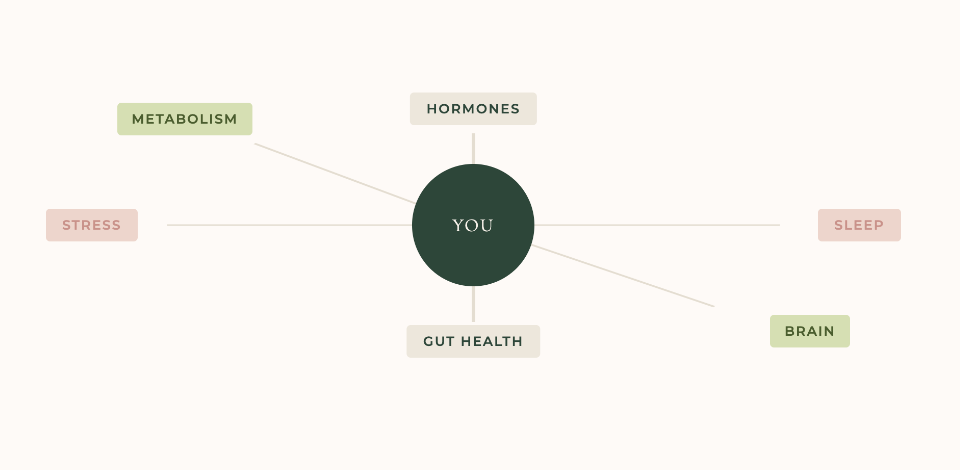
At the same time, the HPA axis becomes more reactive during perimenopause. Elevated cortisol — whether from life stress, blood sugar dysregulation, poor sleep, or inadequate hormonal support — suppresses secretory IgA, the gut's primary immune defense. The result is a more porous, more reactive gut lining that responds to foods that were previously tolerated, amplifies histamine sensitivity, and produces the bloating, altered bowel habits, and abdominal discomfort that so many perimenopausal women are told are just part of aging.
They aren't. They're a solvable clinical problem — when gut health and hormonal balance are addressed together.
Insulin Resistance, the Microbiome, and Metabolic Hormones
No hormone-gut discussion would be complete without insulin. Gut dysbiosis — particularly overgrowth of gram-negative bacteria and decreased microbial diversity — is associated with increased intestinal permeability, elevated LPS, and systemic low-grade inflammation. This inflammatory state directly promotes insulin resistance by interfering with insulin receptor signaling and promoting adipose tissue dysfunction.
The microbiome also influences GLP-1 production. Specific short-chain fatty acids (SCFAs) produced by fiber-fermenting bacteria — especially butyrate — stimulate L-cells in the gut to secrete GLP-1, which in turn enhances insulin sensitivity and promotes satiety. This is one of the reasons a fiber-rich, whole-foods diet consistently outperforms most supplements for metabolic health: it's feeding the bacteria that make the hormones that regulate your metabolism.
For patients with PCOS, insulin resistance, or blood sugar dysregulation, microbiome restoration is not a side project. It's metabolic medicine.
What This Means for Your Care
The clinical takeaway is straightforward, even if the biology isn't: you cannot fully resolve a hormonal condition without evaluating the gut, and you cannot fully heal the gut without accounting for hormonal influences.
This is how Dr. Sand approaches every case. Advanced stool testing, DUTCH hormone panels, organic acid testing, and functional labs give us a complete picture of what's happening at the intersection of your microbiome and your endocrine system — so that treatment targets root causes, not just symptoms.
If you've been cycling through hormonal treatments, gut protocols, or elimination diets without lasting resolution, this lens may be exactly what's been missing.
Frequently Asked Questions
Can gut health affect hormone levels?
Yes, significantly. The gut microbiome regulates estrogen metabolism through the estrobolome, influences thyroid hormone conversion, affects cortisol via the gut-brain-HPA axis, and modulates insulin sensitivity through short-chain fatty acid production. Gut dysbiosis can directly elevate estrogen, suppress thyroid function, and worsen metabolic hormone signaling.
Why does my digestion get worse before my period?
Rising progesterone in the luteal phase of the menstrual cycle slows intestinal motility, causing bloating, constipation, and slower transit. Estrogen fluctuations also affect mast cell activity and gut sensitivity. These are hormonally-driven, predictable changes — not separate GI problems.
What is the estrobolome?
The estrobolome is the collection of gut bacteria that metabolize estrogen. These microbes produce an enzyme (beta-glucuronidase) that affects how much estrogen is reabsorbed from the gut versus excreted. An imbalanced estrobolome is a major driver of estrogen dominance and hormone-related conditions like endometriosis, fibroids, and PMS.
Does leaky gut affect hormones?
Yes. Increased intestinal permeability allows bacterial byproducts (like LPS) to enter circulation, triggering systemic inflammation that disrupts the HPA axis, raises cortisol, promotes insulin resistance, and can drive autoimmune thyroid activity. Gut barrier integrity is a foundational variable in hormonal health.
Can treating SIBO help with hormone imbalances?
Often, yes. Because SIBO creates local and systemic inflammation, disrupts estrogen metabolism, and impairs thyroid hormone conversion, resolving bacterial overgrowth frequently leads to downstream hormonal improvements — including more regular cycles, reduced PMS severity, better thyroid conversion, and improved metabolic markers.
What tests assess hormone and gut health together?
A comprehensive functional medicine workup may include the DUTCH Complete hormone test, GI-MAP stool analysis (including beta-glucuronidase activity), organic acid testing, fasting insulin and glucose, and inflammatory markers. Together, these panels reveal how the microbiome and endocrine system are interacting — and where to intervene first.
Ready to get to the root of your hormonal or digestive symptoms? Book a free 15-minute intro call with Dr. Sand to learn how a functional approach can help.

Dr. Rebecca Sand
Functional & Naturopathic Physician
Licensed Acupuncturist
This post is for educational purposes and does not constitute medical advice. Please consult with a qualified healthcare provider before starting or stopping any treatment.


